Best Instrument Cable for Bass Guitar: What Bass Players Actually Need
Most bass players grab whatever instrument cable is closest and plug in. It works, the signal comes through, and nobody thinks about it again until the cable starts crackling or buzzing.
But bass guitar puts different demands on a cable than a standard six-string. The signal is hotter, the frequencies are lower, and the consequences of a bad cable are more obvious in the mix. A guitarist with a noisy cable can sometimes hide behind overdrive and compression. A bass player with a noisy cable has a 60-cycle hum sitting right on top of the fundamental.
If you are serious about your bass tone, the cable between your instrument and your amp is worth understanding. Not because you need to spend a fortune, but because choosing the right cable once means never thinking about it again.
Why Bass Guitar Is Harder on Cables
Bass pickups, especially passive single-coils and high-output active systems, produce a stronger signal than most guitar pickups. That higher output level means any noise picked up by the cable is riding on top of a louder signal, which sounds counterintuitive. You would expect the stronger signal to mask the noise. But the problem is not the signal-to-noise ratio at the source. The problem is what happens at the amp.
Bass amps amplify everything the cable delivers. A guitar amp with a noise gate and an overdrive pedal can bury a small amount of cable noise under distortion harmonics. A clean bass amp running into a PA system exposes every hum, buzz, and crackle. There is nowhere to hide.
The other issue is mechanical. Bass players move differently than guitarists. You are more likely to be standing in one spot, shifting your weight, and letting the cable drape across the floor where it gets stepped on. The cable takes constant low-level stress at the plug, and bass jacks tend to have tighter tolerances than guitar jacks, which means connector quality matters more.
Low frequencies also interact differently with cable capacitance. While capacitance primarily affects treble rolloff (which matters more for guitar), bass players who use techniques like slapping, tapping, or playing with a pick rely on upper harmonics for note definition. A high-capacitance cable dulls those harmonics and makes the bass sound muddy, which is the last thing you want in a live mix.
What to Look for in a Bass Instrument Cable
The qualities that make a good bass cable are the same qualities that make a good instrument cable in general. But the margin for error is smaller, so the specs matter more.
**Oxygen-free copper (OFC) conductor.** The conductor carries your signal. OFC has fewer impurities than standard copper, which means lower resistance and better signal transfer across the full frequency range. For bass, the low-end extension matters. A cheap cable with a low-grade conductor can subtly compress the bottom end, making your tone feel thinner than it should. OFC eliminates that problem.
**Dense braided or spiral shielding.** Shielding blocks electromagnetic interference from reaching the conductor. Foil shields are common in cheap cables. They work, but they are fragile and tend to crack when the cable flexes. Braided shields are more durable and provide better coverage. Spiral shields are a good compromise between flexibility and protection. For bass, prioritize shielding density over flexibility. You are running a single cable from your bass to your amp, not routing it around a pedalboard. It can afford to be slightly stiffer if that means better noise rejection.
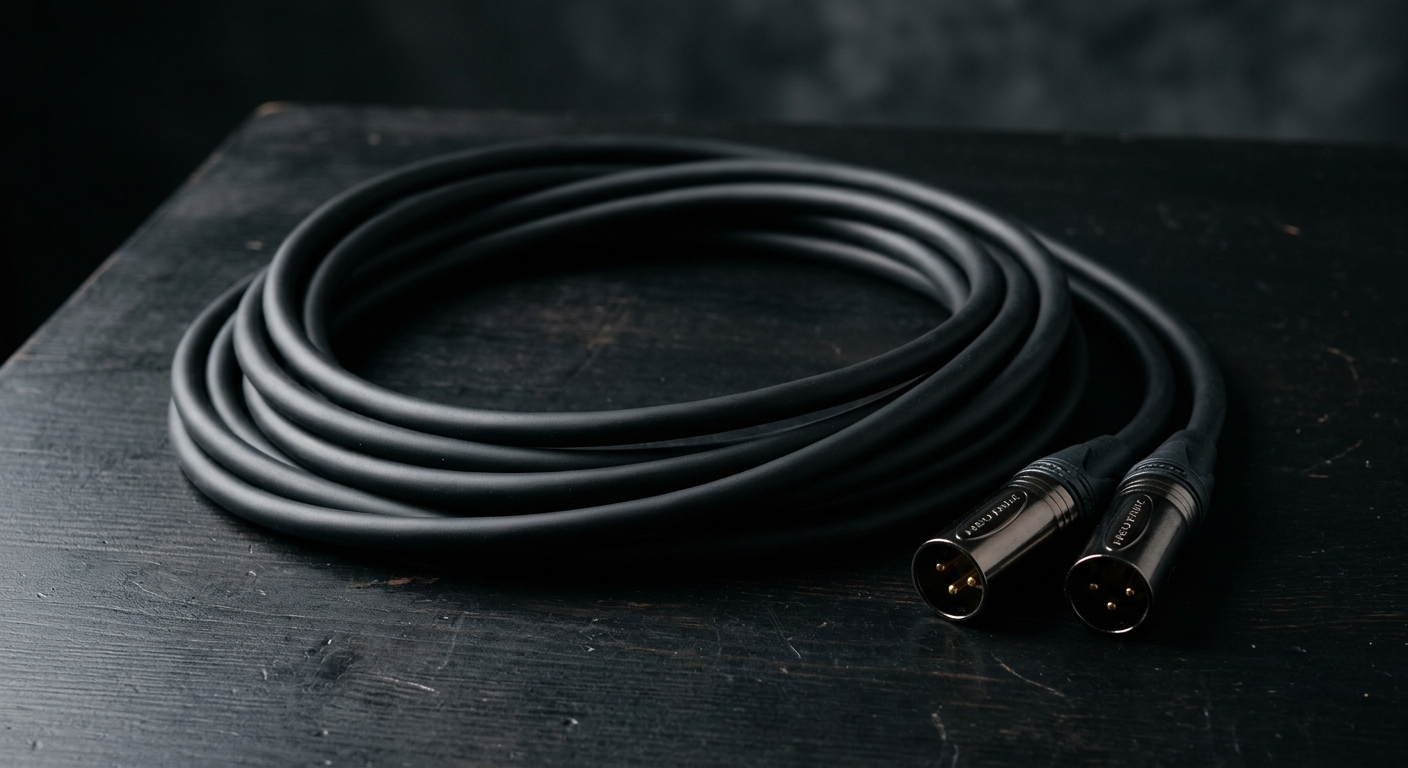
**Quality connectors with real strain relief.** The connector is where cables fail. A good connector has a solid metal barrel, a spring or boot that absorbs stress at the cable entry point, and gold or nickel contacts that maintain a clean connection over thousands of insertions. Neutrik NP2X connectors are the industry standard for a reason. They grip the jack firmly, resist corrosion, and can be opened for inspection or resoldering if needed.
**Appropriate length.** Every foot of cable adds capacitance and introduces a small amount of signal loss. For bass, the practical sweet spot is 10 to 15 feet for most stage situations. That gives you enough slack to move without excess cable coiled on the floor picking up noise. If you need 20 feet, use 20 feet. But do not use 25 feet when 15 would reach.
Active vs. Passive Bass: Does Your Cable Choice Change?
Active basses with onboard preamps have a lower output impedance than passive basses. In practical terms, this means active basses are less affected by cable capacitance. The preamp buffers the signal before it hits the cable, so you can run longer cables without losing high-frequency content.
Passive basses are more vulnerable. The signal goes straight from the pickup to the cable with nothing in between. Cable capacitance has a direct effect on the tone, and longer cables will noticeably roll off the treble. If you play a passive Jazz Bass or Precision Bass, keeping your cable under 15 feet makes a real difference.
Both active and passive basses benefit equally from good shielding and good connectors. The preamp in an active bass does not protect against noise picked up by the cable. It does not filter out hum or reject interference. That is the shield's job. A noisy cable is a noisy cable regardless of what electronics are in your bass.
The takeaway: if you play passive bass, cable quality matters more for tone. If you play active bass, cable quality matters equally for noise rejection. Neither type gets a free pass on cheap cables.
Cable Specs That Actually Matter for Bass
Cable manufacturers publish specs, but most bass players do not know which numbers are meaningful. Here is what to look at.
**Capacitance (measured in picofarads per foot).** Lower is better. Under 40 pF/ft is good. Under 30 pF/ft is excellent. Canare GS-6 measures around 34 pF/ft. Mogami W2524 measures around 27 pF/ft. Both are low enough that you will not notice treble loss at normal cable lengths. Cheap cables often run 50 to 80 pF/ft, which is where problems start.
**Conductor gauge.** Thicker conductors (lower AWG numbers) carry signal with less resistance. For a 10 to 20-foot instrument cable, 20 AWG is standard and perfectly adequate. Some premium cables use 18 AWG for marginally better performance. Below 22 AWG, you are in budget territory and may notice a difference.
**Shield coverage.** Expressed as a percentage. A braided shield with 95 percent or higher coverage provides excellent noise rejection. Spiral shields typically offer 85 to 95 percent coverage. Foil shields can hit 100 percent on paper, but they crack with repeated flexing and lose effectiveness over time. For bass, aim for 90 percent or higher from a braided or spiral shield.
**Jacket material.** PVC is standard. Rubber is more flexible but less durable. Thermoplastic elastomer (TPE) is the best all-around option, combining flexibility with abrasion resistance. The jacket does not affect tone, but it affects how long the cable lasts and how it behaves on stage.
Common Bass Cable Mistakes
Using a speaker cable as an instrument cable. Speaker cables have no shielding. They are designed to carry high-power amplified signals between an amp and a speaker cabinet. Plugging a bass into an amp with a speaker cable works, but you will pick up every source of electromagnetic interference in the room. The resulting hum and buzz will be significant.
Using a cable that is too long. A 25-foot cable coiled on the floor is an antenna. The extra length adds capacitance that dulls your tone and the coiled section picks up interference from stage lighting, power cables, and other gear. Use the shortest cable that gives you the movement you need.
Ignoring the connector. Many bass players blame the cable when the problem is actually the plug. A connector that does not seat firmly in the jack creates an intermittent connection. Every time the cable moves, the signal cuts briefly. This sounds like a bad cable, but it is actually a worn or undersized plug. Neutrik and Switchcraft connectors are sized to grip standard quarter-inch jacks firmly. Generic connectors are often slightly undersized and develop play over time.
Storing cables in knots. Wrapping a cable around your elbow in a figure-eight pattern or knotting it for storage puts stress on the internal conductors. Over time, this creates weak spots where the shield separates from the conductor, causing intermittent noise. Use the over-under coiling method: alternate one overhand loop with one underhand loop. The cable will lie flat, uncoil without tangling, and last significantly longer.
Our Recommendation for Bass Players
The Forever Cables Stage Cable is built with Mogami W2524 wire. Mogami W2524 has a capacitance of approximately 27 picofarads per foot, which preserves the full harmonic content of your bass signal, including the upper-register clarity that slap technique and pick playing depend on.
Each cable is hand-soldered with Neutrik NP2X-B connectors. Neutrik plugs grip the jack firmly, resist corrosion, and can be opened for inspection or repair. The strain relief boot distributes mechanical stress across a wider area, preventing the solder joint from fatiguing at the entry point.
The Stage Cable is available in 10, 15, and 20-foot lengths. For most bass players, the 15-foot length is the right choice. It reaches from your bass to a stage amp or DI box with comfortable slack, without the excess cable length that adds capacitance and picks up noise.
Every Stage Cable carries our lifetime guarantee. If it ever fails, for any reason, we replace it. That is the whole policy. No receipt, no expiration date, no fine print.
The Bottom Line
Bass guitar is less forgiving of cable problems than guitar. The signal is hotter, the amp is cleaner, the mix is less cluttered at the low end, and every bit of noise and tone loss is audible. A good instrument cable solves all of these problems at once.
Look for OFC conductors, dense shielding, quality connectors, and appropriate length. Skip the cheapest option on the wall, skip the speaker cable in the pile, and invest in a cable you will not have to think about again.
The difference between a $12 cable and a $40 cable is not subtle for bass. It is the difference between a clean, full low end and a signal that hums, buzzes, and loses definition in the upper register. Choose once, choose right, and move on to the things that actually require your attention.
Built for This
The Stage Cable is built for bass: Mogami W2524 wire, Neutrik NP2X connectors, and a lifetime guarantee. If it fails, you get a replacement. No questions, no expiration.
Stay in the loop
New gear guides, limited promos, and launch updates. No spam.