Instrument Cable vs. Speaker Cable: What Is the Difference and Why It Matters
Instrument cables and speaker cables both use 1/4-inch TS connectors. They look the same on the outside. You can plug either one into the same jack. And that is exactly why so many guitarists use the wrong cable in the wrong place without ever knowing it.
The consequences range from annoying (extra noise, hum, buzzing) to expensive (a damaged output transformer on a tube amp). Understanding the difference between these two cables is one of the most practical things a guitarist can learn, and it takes about five minutes.
What Is an Instrument Cable?
An instrument cable carries a low-level, high-impedance signal from your guitar pickups to your amp or pedalboard. The signal is small, typically millivolts, and it is electrically fragile. It is susceptible to interference from lighting fixtures, power lines, dimmer switches, phones, and any other source of electromagnetic radiation nearby.
To protect that signal, instrument cables are built as shielded cables. The center conductor carries the signal, and a surrounding layer of braided or spiral-wound copper wire acts as a shield. This shield wraps around the signal conductor and is connected to ground, forming a barrier that blocks external electromagnetic interference from reaching the audio signal.
Instrument cables also have relatively thin center conductors, typically 20 to 24 AWG, because the signal they carry requires almost no current. The power demands are negligible; what matters is preserving the signal quality over the cable run.
The shielding and the thin conductor make instrument cables flexible but not designed for high-power applications. They are the right tool for connecting guitar to amp, guitar to pedalboard, or pedalboard to amp front input.
What Is a Speaker Cable?
A speaker cable carries a high-power, low-impedance signal from your amplifier's power section to the speaker cabinet. After your amp has amplified your guitar signal from millivolts to several watts (or tens or hundreds of watts), that amplified signal needs to travel from the amp head to the speakers.
Speaker cables are built with thick, heavy-gauge conductors, typically 12 to 16 AWG, to handle this power without significant resistance losses. They carry real current; a 50-watt tube amp can push several amps of current through a speaker cable at high volume.
Speaker cables are unshielded. They do not need shielding because the signal they carry is already amplified to a level where external electromagnetic interference is irrelevant. The signal is so strong that a little noise from a lighting rig is not going to affect what comes out of the speaker.
The lack of shielding and the heavy-gauge conductors make speaker cables thicker, stiffer, and cheaper to manufacture than instrument cables. They are built purely for efficient power transfer, not signal integrity.
Why They Look the Same
Both cable types use the same 1/4-inch TS (tip-sleeve) connector because the jacks on guitars, amps, and speaker cabinets use the same physical format. This is a legacy of early audio equipment design, and it has never been standardized away.
Some modern amp heads use Speakon connectors for speaker outputs, which eliminates the confusion entirely. But the vast majority of guitar amps, especially combo amps and many boutique heads, still use 1/4-inch jacks for both the input (instrument) and the speaker output.
This means you can physically plug an instrument cable into a speaker jack, or a speaker cable into an instrument jack. The connector fits. The cable works, at least for a while. The problem is what happens electrically.
What Happens When You Use the Wrong Cable
Using a speaker cable as an instrument cable is the less dangerous mistake, but it still causes real problems. Since speaker cables have no shielding, they act as antennas, picking up every source of electromagnetic interference in the room. You will hear hum from power lines, buzz from lighting dimmers, radio interference, and noise from nearby electronics. The signal will be noticeably noisier than it should be, and the noise gets worse in electrically noisy environments like stages and rehearsal spaces.
Some players have used unshielded speaker cable as an instrument cable for months without realizing the cable was the source of their noise problems. If you have mysterious hum that disappears when you unplug your guitar cable from the amp but stays when the guitar is connected, an unshielded cable is one of the first things to check.
Using an instrument cable as a speaker cable is the dangerous mistake. Instrument cables use thin conductors designed for millivolt signals. When you push several watts of amplifier power through those thin conductors, the wire heats up. The thin shielding absorbs power as heat. The cable's capacitance and inductance interact with the amplifier's output stage in ways the amp was not designed for.
In the short term, this causes signal loss, reduced volume, and muddy tone from the speakers. The cable is acting as a resistor and low-pass filter in the power path.
In the long term, this can damage the amplifier. Tube amps are particularly vulnerable. A tube amplifier's output transformer expects to see a specific impedance load (the speaker). An instrument cable adds resistance between the amp and the speaker, which changes the load the output transformer sees. This mismatch can cause the output tubes to work harder, the transformer to overheat, and in extreme cases, the transformer to fail. Output transformer replacement on a tube amp can cost $200 to $500 or more.
Solid-state amps are more tolerant of impedance mismatches, but they still lose power and tone quality when driven through an instrument cable. There is no scenario where using an instrument cable as a speaker cable improves anything.
How to Tell Them Apart
Most speaker cables are labeled. Look for text printed on the outer jacket that says "speaker cable," "speaker wire," or lists a heavy gauge (12 AWG, 14 AWG, 16 AWG). Instrument cables are usually labeled "instrument cable" or list the manufacturer and model number of the cable body (Mogami W2524, Canare GS-6, etc.).
If the labeling has worn off or was never printed, there are a few physical clues. Speaker cables are generally thicker and stiffer because of the heavier gauge conductors inside. Instrument cables are more flexible and thinner.
You can also check the weight. A 10-foot speaker cable is noticeably heavier than a 10-foot instrument cable of the same outer diameter.
The definitive test is a continuity check with a multimeter. On a speaker cable, the tip and sleeve each have a direct, low-resistance connection to the conductor wires, with no shielding. On an instrument cable, the sleeve terminal connects to the shield (braided or spiral-wound copper), and the tip terminal connects to the center conductor.
The simplest habit: label your cables when you buy them. A small piece of colored tape or a cable tag at the connector eliminates confusion permanently. Red tape for speaker cables, no tape for instrument cables, or whatever system works for you.
When You Need Each Type
Use an instrument cable for every connection that carries your guitar signal before it reaches the power amp stage. That includes guitar to amp input, guitar to pedalboard, pedalboard to amp input, effects loop send and return, and any connection between pedals on your board.
Use a speaker cable only for the connection between your amp head's speaker output and your speaker cabinet. This is the only connection in a typical guitar rig that carries high-power amplified signal.
If you play a combo amp (where the amp and speaker are in the same cabinet), the speaker cable is internal and you never need to think about it. Every external cable you use with a combo amp is an instrument cable.
If you play through an amp head and separate cabinet, you need one speaker cable (head to cab) and one or more instrument cables (guitar to head, or guitar to board to head).
A Note on Combo Amps and Internal Wiring
Combo amps have the speaker cable wired internally from the output transformer to the speaker. You never see it or touch it. Every cable you plug into a combo amp externally is an instrument cable: the input jack, the effects loop, the footswitch jack.
Some combo amps have an external speaker output jack for connecting an additional cabinet. That jack requires a speaker cable. It is the one exception; every other external cable connection on a combo amp is an instrument cable.
The Bottom Line
Instrument cables are shielded, thin-conductor cables designed to carry your guitar signal cleanly. Speaker cables are unshielded, heavy-conductor cables designed to carry amplifier power efficiently. They serve completely different purposes despite using the same connector.
Using a speaker cable as an instrument cable gives you noise. Using an instrument cable as a speaker cable can damage your amp. Neither is a good outcome, and both are completely avoidable by simply knowing which cable goes where.
Label your cables, keep them separate, and never substitute one for the other. It is one of the easiest ways to protect your gear and keep your signal clean.
Built for This
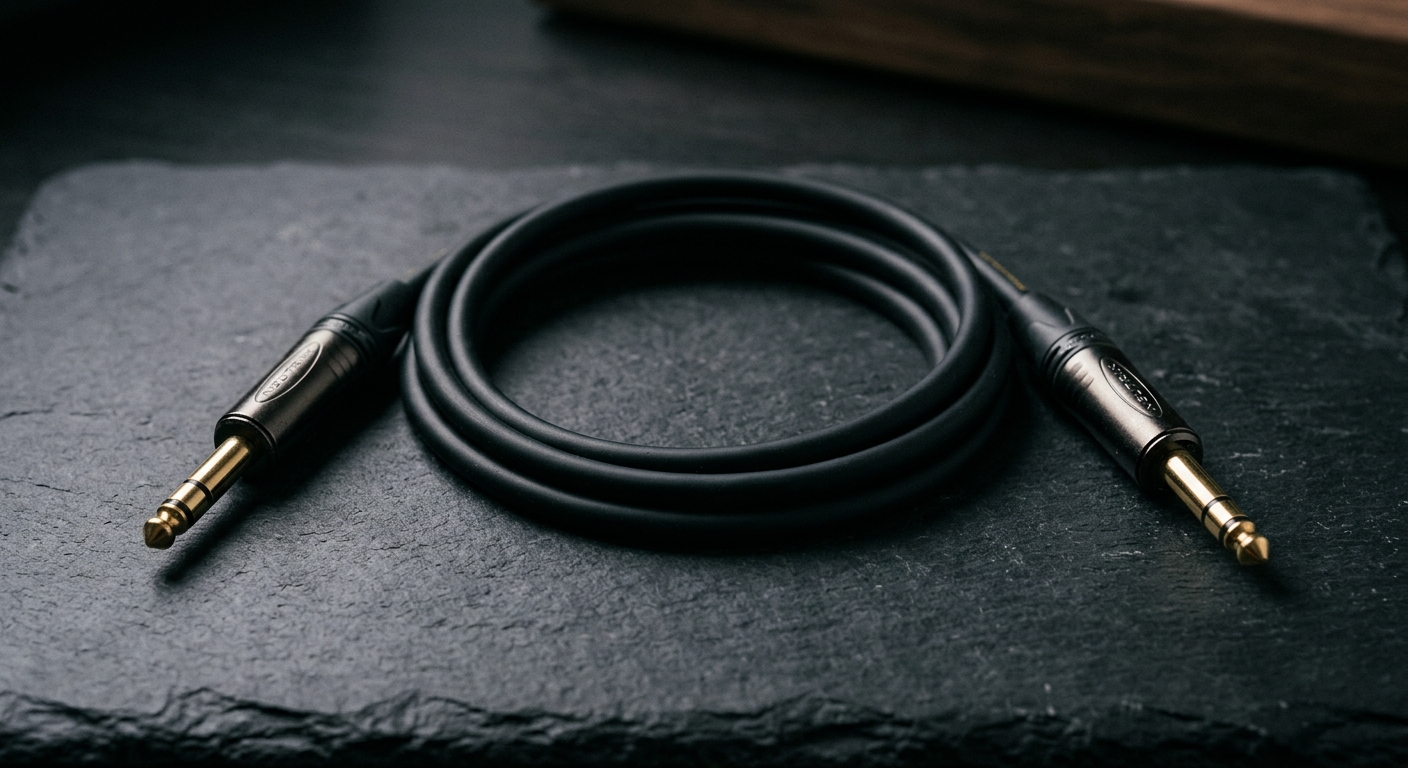
The Forever Cables Stage Cable is a proper instrument cable built with Mogami W2524 wire, Neutrik connectors, and hand-soldered joints. For running from your guitar to your amp or pedalboard, it is built to last a lifetime.
Stay in the loop
New gear guides, limited promos, and launch updates. No spam.