TRS vs TS Guitar Cables: What Is the Difference and Which Do You Need?
If you have spent any time shopping for guitar cables, you have probably noticed two connector types that look nearly identical: TS and TRS. Same size, same metal barrel, same 1/4-inch plug. The only visible difference is a tiny extra ring on the TRS connector.
That small ring changes what the cable can do. Using the wrong type will not damage anything, but it can cause signal problems that are confusing to diagnose. This guide explains what each type is, how they differ, when you need each one, and what Forever Cables uses in our product line.
What Is a TS Cable?
TS stands for Tip-Sleeve. The connector has two contact points: the tip carries the audio signal, and the sleeve carries the ground. Inside the cable, there are two conductors: a center signal wire and a surrounding shield that doubles as the ground path.
TS cables carry a mono, unbalanced audio signal. This is the standard guitar cable configuration. Your guitar outputs a single mono signal from its pickups, and a TS cable is designed to carry exactly that.
Every standard guitar cable, instrument cable, and patch cable for pedalboards is a TS cable. When someone says "guitar cable" or "instrument cable" without further qualification, they mean a TS cable.
The vast majority of guitar gear uses TS connections: guitar output jacks, amp input jacks, effects pedal inputs and outputs, and pedalboard patch connections. Unless you are using specific stereo effects or balanced pro audio equipment, TS is what you need.
What Is a TRS Cable?
TRS stands for Tip-Ring-Sleeve. The connector has three contact points: tip, ring, and sleeve. Inside the cable, there are three conductors instead of two. That extra conductor enables two different functions depending on the application.
In balanced audio applications, the TRS cable carries the same signal on both the tip and ring conductors, but with one inverted. The receiving device compares the two signals and cancels out any noise that entered the cable during the run. This is how professional audio gear achieves clean signal transfer over long cable runs, typically 50 feet or more.
In stereo applications, the TRS cable carries two separate audio channels: one on the tip, one on the ring. This is how headphone cables work (the tip carries the left channel, the ring carries the right channel, and the sleeve is the shared ground).
A TRS cable can also be used for insert connections on mixing consoles, where the tip carries the send signal and the ring carries the return signal on the same cable.
The Key Differences
The core difference is the number of conductors. A TS cable has two conductors (signal and ground). A TRS cable has three conductors (two signal paths and ground). This gives the TRS cable the ability to carry either a balanced mono signal or a stereo signal, while a TS cable carries only an unbalanced mono signal.
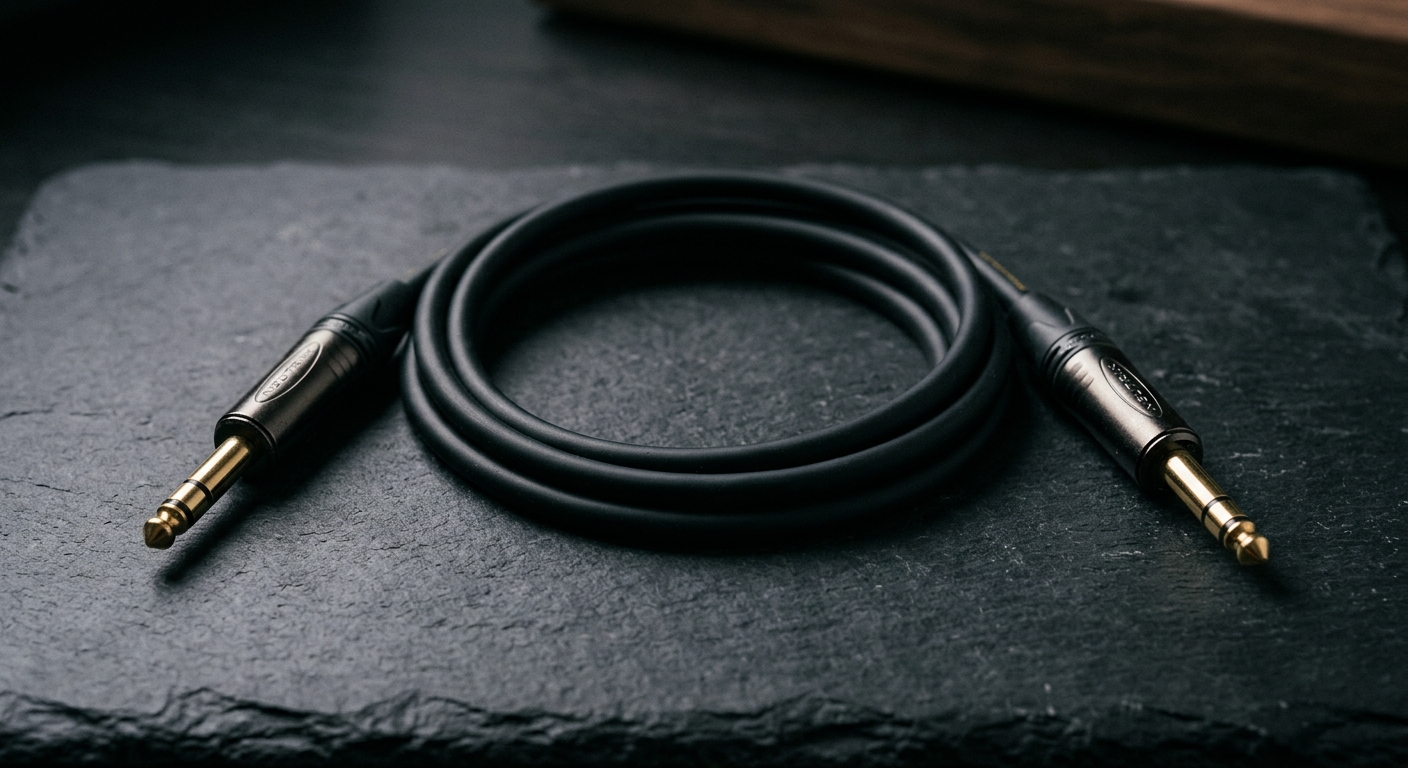
Connectors: TS connectors have one black insulating ring separating the tip from the sleeve. TRS connectors have two black insulating rings, creating three distinct contact sections. This is the quickest way to visually tell them apart.
Impedance handling: TS cables are designed for the high-impedance, low-level signals that guitar pickups produce. TRS cables in balanced configurations are designed for lower-impedance professional audio signals.
Noise rejection: TS cables rely on their shield for noise rejection. TRS cables in balanced mode use differential signaling (common-mode rejection) to cancel noise, which is significantly more effective over long distances.
Cost: TRS cables cost slightly more than equivalent TS cables because of the extra conductor and more complex connector construction. The difference is small, typically a few dollars.
When to Use TS Cables
For most guitar applications, TS cables are the correct choice. Use a TS cable for connecting your guitar to your amp, connecting your guitar to your pedalboard, connecting pedals to each other on your pedalboard (patch cables), connecting your pedalboard output to your amp input, and connecting effects loop send and return on most amps.
The guitar signal path is fundamentally mono and unbalanced. Your pickups output a single-channel signal. Your amp expects a single-channel input. Every pedal in your chain processes a mono signal. TS cables are built for exactly this signal type.
All Forever Cables products (Workhorse, Right Angle, and Stage Cable) are TS cables because they are designed for guitar signal chains where TS is the correct standard.
When to Use TRS Cables
TRS cables appear in guitar rigs less often than TS cables, but there are specific situations where you need one.
Stereo effects pedals: some chorus, reverb, and delay pedals have stereo outputs that require TRS cables (or dual TS cables) to send separate left and right channels to two amplifiers. Check your pedal manual; not every pedal with two output jacks requires TRS. Many use two standard TS jacks instead.
Expression pedals: many expression pedals (volume pedals, wah controllers, parameter expression inputs) use TRS connections. The tip sends voltage, the ring receives the variable voltage from the pedal wiper, and the sleeve is ground. Using a TS cable with an expression pedal will either not work at all or give you only on/off control instead of smooth variable control.
Y-insert cables: if your amp or mixer has an insert point for outboard effects, the insert jack typically uses a TRS connector where the tip is the send and the ring is the return. A Y-cable with TRS on one end and two TS plugs on the other is the standard tool for this.
Balanced DI outputs: if you run your guitar signal into a DI box for the front-of-house PA, the DI box may have a balanced 1/4-inch TRS output in addition to (or instead of) an XLR output. A TRS cable carries the balanced signal to the mixer with noise rejection over long cable runs.
Headphone outputs: amp headphone jacks use TRS (or TRRS for mic-equipped headphones) to deliver stereo audio. Your standard guitar cable will work in a headphone jack but will only produce mono audio in one ear.
Can You Use a TRS Cable Where a TS Cable Is Expected?
Yes, in most cases. A TRS plug will physically fit any standard 1/4-inch jack. When you plug a TRS cable into a TS jack, the ring contact has nothing to connect to, so the cable behaves as a standard TS cable. The tip carries the signal, the sleeve carries ground, and the ring is ignored.
There are rare exceptions. Some older or unusual equipment has TS jacks with a slightly different internal geometry that does not make proper contact with the longer TRS plug. This can cause intermittent signal issues. But with modern gear from reputable manufacturers, a TRS cable in a TS jack works without problems.
The reverse is more problematic. If a device expects a TRS cable and you use a TS cable, the ring contact in the jack shorts to ground (because the TS plug sleeve covers both the ring and sleeve contacts). In expression pedal applications, this means the pedal receives a fixed ground signal on the ring instead of a variable voltage, which disables the expression function. In balanced audio applications, shorting the ring to ground defeats the balanced connection and the cable operates as unbalanced.
What Forever Cables Uses and Why
Every cable in the Forever Cables product line uses TS connectors because our cables are designed for the guitar signal chain. The Workhorse and Right Angle patch cables connect pedals on your pedalboard. The Stage Cable connects your guitar to your board or your board to your amp. All of these connections are mono, unbalanced, and standardized on TS.
We use Neutrik NP2X-B connectors (straight TS) and NP2RX-B connectors (right-angle TS) because they are the industry standard for professional guitar cables. Gold-plated contacts resist oxidation. Machined brass bodies maintain tight tolerances over thousands of plug cycles. Integrated strain relief protects the hand-soldered joint from mechanical stress.
If you need a TRS cable for a specific application (expression pedal, stereo effects routing, or balanced output), that is a different product for a different signal type. For everything else in a standard guitar rig, TS is the correct choice.
Frequently Asked Questions
Do I need a TRS cable for my guitar? No. Standard electric guitars output a mono, unbalanced signal on a TS connection. A TRS cable will work physically but provides no benefit. Use a TS cable.
Will using the wrong cable type damage my gear? No. Using a TS cable in a TRS jack (or vice versa) will not damage your equipment. It may cause the connection to not function correctly (especially with expression pedals), but there is no risk of electrical damage.
How can I tell if my cable is TS or TRS? Look at the plug. Count the black insulating rings between the metal sections. One ring means TS (two contacts). Two rings means TRS (three contacts).
Do TRS cables sound better than TS cables for guitar? No. For a standard guitar signal chain, both cable types carry the same signal in the same way. The extra conductor in a TRS cable provides no benefit unless the equipment on both ends is designed to use it.
What about TRRS cables? TRRS (Tip-Ring-Ring-Sleeve) cables have four contacts and are used primarily for headsets with built-in microphones. They are not used in guitar applications.
Built for This
Forever Cables uses TS connectors with Neutrik gold-plated contacts, hand-soldered on Canare GS-6 or Mogami W2524 wire. Every cable is backed by our lifetime guarantee.
Stay in the loop
New gear guides, limited promos, and launch updates. No spam.